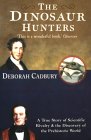
The Dinosaur Hunters: A True Story of Scientific Rivalry and the Discovery of the Prehistoric World
Full of quotes from contemporary sources, The Dinosaur Hunters brilliantly evokes the Dickensian world of early Victorian science and society. From Mary Anning, the self-taught fossil hunter of Lyme Regis to Gideon Mantell, to the academic and eccentric Dean Buckland of Oxford University, the story tells of reputations made and lost in the emerging story of the geological past. Deborah Cadbury, an award-winning TV science producer and acclaimed author has thoroughly researched her topic and steeped herself in the intricacies of the scientific debates of the time. With black and white illustrations, extensive notes, a bibliography and index, the result is one of the best popular science histories.
Readers Reviews on Amazon.....
"The Dinosaur Hunters tells the story of the pioneers of dinosaur discovery in England. These were a mixed bunch indeed, and this is what I found truly fascinating. That Mary Anning, a woman on the poverty line, could play as big a part as Gideon Mantell and establisment figure Richard Owen is extraordinary."
"We take the dinosaurs for granted these days, and it is easy to forget that nobody had much of a clue what they would have looked like or what size they were after finding the first few bones. The book brings this discovery to life and puts the flesh on the bones"
Read reviews, or buy this book online from


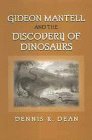
Gideon Mantell and the Discovery of Dinosaurs
Dennis Dean, a retired American university academic, has done Mantell and the history of the science of the period a great service. His meticulously researched biography is a tour de force and gives the reader the feeling that no stone has been left unturned in researching this story. It is fairly academic in tone with lots of footnotes and references. But those bitten by the dinobug are fairly used to arcane details. Dean was particularly lucky to have found a previously unused and major source of Mantell manuscripts and documents, hidden away in New Zealand. It turns out that Mantell's son, Walter Mantell (1820-1895) took his fathers effects to New Zealand in 1859 and eventually donated them to the Alexander Turnbull Library in Wellington. The story Dean tells gives fascinating insights into the struggle the scientists of the time had dealing with the new fossil material which was literally turning all preconceived ideas of the prehistoric world upside down. Nothing in the living world could prepare them to cope with the peculiarities of the extinct fossil reptiles. Dean clearly admires Mantell and his work and goes to great length's to put his side of the story, which has been otherwise obscured particularly by the larger reputation of Sir Richard Owen. The intricacies of the plot and the characters are worthy of Charles Dickens.
Read reviews, or buy this book online from
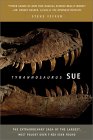
Tyrannosaurus Sue: The Extraordinary Saga of the Largest, Most Fought Over T-rex Ever Found
In 1990, the skeleton of a battle-scarred Tyrannosaurus rex matriarch was found, virtually complete, in what many call the most spectacular dinosaur fossil discovery to date. Not just another dinosaur book, Tyrannosaurus Sue is a fascinating introduction to the centuries-old history of commercial fossil hunting, a legal thriller and a provocative look at academic versus commercial science and the chase for the money that fuels both. - Steve Fiffer, an attorney who has followed the story for the past seven years, has captured the whole range of characters and issues embroiled in the fight for Sue. Fiffer communicates both the excitement over Sue's discovery and the motivations, manoeuvrings, and absurdities of the various forces attempting to control her destiny.Read reviews, or buy this book online from
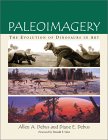
Paleoimagery: The Evolution of Dinosaurs in Art
Other than seeing them in popular movies such as Jurassic Park, how do people today know what dinosaurs and other prehistoric animals looked like? Only their bones remain, but thanks to paleoartists, whose work is found in books and museums, most people have a good idea of what these creatures looked like. The world of paleoart and its artists are the subject of this richly illustrated work. It explores themes in the depiction of dinosaurs and other prehistoric animals, paleoart's history and speculative nature and its effect on scientists' impressions of prehistoric animals. Also explored are such topics as the careers of several paleoartists, including Georges Cuvier, Gideon Mantell, John Martin, Henry Ward, Benjamin Waterhouse Hawkins and Charles R. Knight, the depiction of scientific ideas about dinosaurs and prehistoric animals on canvas and in sculpture, the purpose and process of restoring them in museums, the significance of certain restorations and images, and the development of paleoart in America
Read reviews, or buy this book online from
Feathered Dragons: Studies on the Transition from Dinosaurs to Birds
Meat-eating theropod dinosaurs have been recognized as potential ancestors of birds since the 19th century, but it was not until the 1960s that work on Deinonychus revealed the startling similarities between dinosaurs and birds. With each new small theropod find the ties became stronger, until the discovery of Sinosauropteryx - a dinosaur with feathers! Though not all scientists accept the concept of birds' being phylogenetically nested within the Dinosauria, others are now focusing on the evolution of feathers and avian flight. This book presents 15 new pieces of research, including the first detailed description of Bambiraptor, a remarkable new specimen from Montana.
Read reviews, or buy this book online from
The Dinosaur Heresies by Robert T. Bakker
You needn't be a dinosaur addict to enjoy this book and benefit from it. This book shows why Bakker's elevated position is deserved - and why his assertions are resented by some of his colleagues. His observations challenge lazy thinking - by his colleagues and the rest of us also.
Bakker knows that challenging conventional' judgment requires innovative thinking backed by solid evidence. It's precisely the problem Darwin faced when introducing evolution through natural selection. The evidence is there, it simply takes a perceptive eye and logical thinking to clarify its meaning. Bakker is able to perform those feats, bringing fine writing in to use vigorously presenting his conclusions . Much of the fossil data has an extensive history. He has an uncanny ability to make field research understood by a wide spectrum of readers. No arcane ivory-tower scientist here; evidence and conclusions are clear and unambiguous. Supporting his prose are fine illustrations ranging from serious reconstructions to clever speculation.
Read reviews, or buy this book online from
Describes a 1999
expedition from the University of Pennsylvania designed to retrace the
travels of Dr. Ernst Stromer who, in 1911, led an expedition to Egypt's
Bahariya Oasis in the Sahara, where he discovered new species of dinosaurs,
a discovery that was lost in 1944 during Allied bombing of Munich
Read reviews, or buy this book online from
Until quite recently, French zoologist Georges Cuvier (1769-1832) opposed the biological theory of evolution, and championed the geological theory of catastrophism; but his research on fossils helped form and bring credibility to geology and palaeontology, and recent research has proved that his ideas on the importance of mass extinctions and catastrophes were well ahead of their time. In this volume, Martin Rudwick provides a modern translation of Cuvier's essential writings on fossils and catastrophes, together with two previously unpublished pieces. Rudwick links these translated texts together with his own narrative and interpretive commentary, placing Cuvier's work in its biographical, scientific, and social context. A major feature of this book is a translation of Cuvier's best-known work, the "Preliminary Discourse" (1812). Frequently reprinted and translated, this essay became a key document in 19th-century debates about evolutionary theory, and can still be used as source material by many English-speaking historians.
Read reviews, or buy this book online from
The
Map That Changed the World: The Tale of William Smith and the Birth
of a Science
Read reviews, or buy this book online from
The Dinosaur Hunter's Kit: Discover the Traces of a Lost World
Hunt for dinosaurs just like a real paleontologist! Study the fully-illustrated book to learn how fossils are located and collected, how and why they are studied, and what we've been able to learn about dinosaurs. Read authentic-looking field notes from a dig, then write your own as you begin to excavate the kit's rock slab to uncover your own replica of an Apatosaurus fossil.
Read reviews, or buy this book online from
This is a photographic
collection of realistic models, bones, and skeletons which show the
biggest, the fastest, and the fiercest of these terrible monsters. Lively
text and labels are linked to the pictures to help early readers with
their language skills, while questions prompt discussion about how,
why, what and when things happen. There is a pronunciation guide to
help parents with all those long and unfamiliar names.
Read reviews, or buy this book online from
Robert Bakker illustrates the new and unprecedented wave of dinosaur discoveries around the world, while David J Varicchio discusses the familial relationships of dinosaurs. Walter Alvarex and Vincent Courtillot debate their theories of mass extinction, and Ken Carpenter describes the latest technologies and basic techniques of excavating fossils. Together, they provide a detailed impression of what life was like for the thunder lizards: what they looked like, how they acted and interacted, what they ate, where they lived, and how they died. With a sharp, accessible design and loads of illustrations, this book is truly something to roar about.
Read reviews, or buy this book online from
Perfect for all dinosaur-mad kids from 3 upwards! Meet the biggest, smallest, fiercest and weirdest dinosaurs that ever walked on Earth!
Dinosaurs came in all shapes and sizes. Some were huge - the size of a house! Others were much smaller - like little chickens. Some were covered in armour - spikes, horns and clubs. Others were covered in feathers. But whatever they looked like, dinosaurs continue to fascinate young children everywhere - this is a book just for them